Saturday, August 17, 2019

Many States, Many Kids

Before this summer, I had rarely left the Midwest. But as I was looking around at possible internships this past Spring, I learned about an internship with a company called We Are Camps. This company provides many different summer camps for kids primarily age 9 and older. The specific camps I signed up to do was a sports camp program that took place at Air Force Bases all over the continental United States, far out of my usual area of work.

Right after school ended in mid-May, all coaches for the program including me got together in Champaign Illinois (where our supervisor lives) to have a week of training. This training was to teach us about the rules of the sports, how to teach them with various lessons and activities and how to keep the kids involved. The reason we had to learn how to do the sports is because the sports that we were going to teach each day of the week were sports that are not considered 'traditional' American sports. These sports were: lacrosse, ultimate frisbee, handball, badminton, fencing and shallow-end water polo.

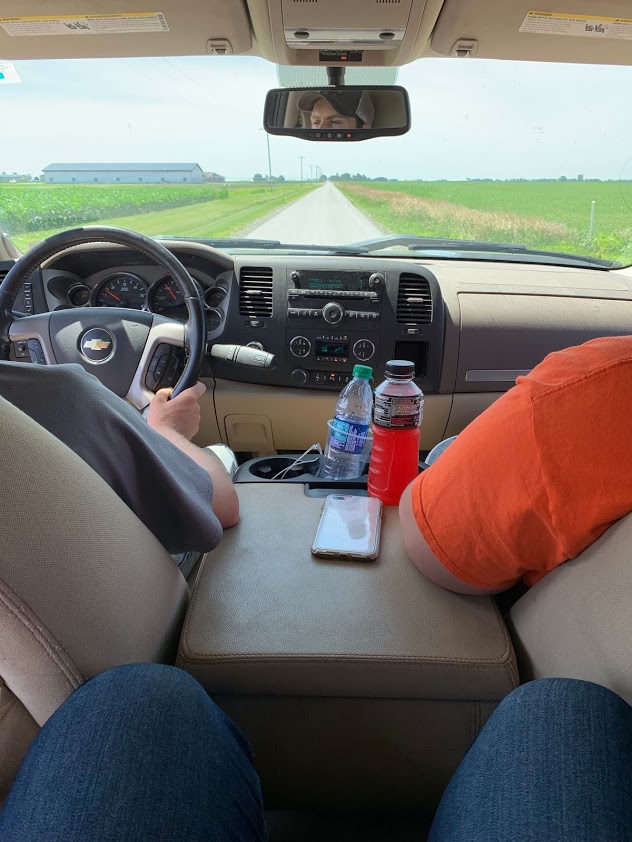
Once the program started I was paired up with another coach and we took off together with a rented truck and trailer filled with the necessary equipment for the sports we were teaching. All through the summer we would spend a week at one base, teach a new sport to the on-base kids each day and then at the end of the week, we would pack up and move on to the next base. Our first camp started on June 10 in Salt Lake City, and our last camp ended on August 16 near Columbia MO.

At first, I had strong doubts about my ability to be a good coach and I'll admit the first couple weeks were a little rough because this was a type of teaching/instruction that I had never done before, and I often struggled with pacing, volume of voice and speaking in terms that younger kids could understand. But as the summer progressed, our lessons greatly improved and my partner and I got into a good rhythm of coaching.

Along with the equipment, we brought a binder with a script that showed us the order of lesson points and activities to do each day to ensure that the kids were learning. My project for the summer was to develop a script for the sport of field hockey which is a sport our supervisor has wanted to add to the program. As I was putting it together, I was considering what I was learning throughout the summer such as methods to keeps kids paying attention and how to ensure that they were enjoying the sport. Once I finished the script I was given the chance to practice it with one of the group of kids we were teaching, and it went rather well (with room for improvement).

What I learned over the summer and with this project is that teaching or coaching younger kids is a challenging but often rewarding experience that requires many things such as patience and understanding. You have to realize that some kids are more than willing to put in the effort while others may not do the same. You also have to remember that you show the kids in your instruction that you are enjoying being their coach, because if they get the impression that you are not enjoying being with them, they notice.

This past summer was an amazing adventure. From coaching kids of all kinds from all parts of the country, I learned many things about myself and accomplished things I didn't realize I was capable of. My time as a coach for these military kids is definitely an experience that I will never forget.

Friday, August 16, 2019

Rise Up To New Opportunities

Sometimes when one door closes, another one opens to a new opportunity.  I was originally going to work for Earlybird Feed and Nutrition, but things changed at the last minute.  April came around and I was without a summer internship.  Through local connections, I learned that a Pontiac car dealership was looking for a summer intern to help in the Parts Department.  I never thought that I would have worked for a car dealership, but I went outside of my comfort zone to get experience working for another industry.
This summer, I had the opportunity to work for Heller Motors a family-owned car dealership in Pontiac, Illinois.  They have been in business for over 60 years and also have a Ford dealership in El Paso, Illinois.  I worked in the Parts Department where I stocked shelves with parts, located parts technicians needed, billed parts on customer invoices, and picked up/delivered parts to other dealerships. 

My internship began on May 13th, and I spent the first few days training and understanding the computer system I would be using throughout the summer.  I shadowed full-time employees when they would look up parts for cars to familiarize myself when doing tasks on my own.  I quickly learned within the first few days that there is no normal day when working in the Parts Department.  There were days when we would be looking up parts, ordering parts, and talking with customers on the phone and then the next day we would be looking for things to do to stay busy. 

I learned so much in the short amount of time I worked for Heller Motors.  I came in with no prior experience working with car parts and did not take any auto classes in high school.  I quickly caught on to everything that I was asked to do and enjoyed working with the three other employees in the department.  I am at a loss of words and cannot thank the employees enough for helping me whenever I had a question and being patient with me especially during the first few weeks of my internship.

In conclusion, I learned so many important skills that will benefit me in my future endeavors.  Communication is very important when speaking with customers on the phone about ordering parts for their car and letting them know when their parts came in.  I quickly figured out that organization is critical in the Parts Department making sure you can find oil filters, air filters, and brake pads in a timely manner for technicians when they need them.  Service is key when it comes to working for a car dealership and pleasing customers. 

The Unexpected Teaching Oppurtunity


“Everything happens for a reason.” 


Accepting a communications internship lead me to believe that I would be gaining more social media, radio and networking experience, which I was super excited to learn more about. What I was not expecting was to fall in love with my work every day because of an experience that was not in the job description. 
I am one of two communications interns at the Illinois Corn Marketing Board this summer. The other intern was not a usual pick at Illinois Corn because she had no agriculture experience at all. At first, I was really confused as to why she was here and even more importantly, how she got hired. She is a broadcast/journalism major from Illinois State University, and she found this internship from a professor at school. 
Illinois Corn was wanting to do some video work this summer and I was nervous because I have not had much experience making or editing videos. The other intern was hired because of her previous video experience which made me feel more at ease about the future tasks. On her first week on the job, we had Illinois Corn Growers Association and Illinois Corn Marketing Board meetings here in the office. As we sat through some meetings, I could see her eyes glazing over on the farming lingo and jargon they were using that I had been hearing most of my life. She was timid about asking questions at first, but I could tell she was curious to learn. This was my unexpected but amazing opportunity.
Throughout the summer, as we traveled to farms, businesses, and ethanol plants I would explain details that she likely would not know about. I got to use all of my Ag Ed knowledge and teach her in a way that she could understand but not in a way that would make her feel dumb for not knowing the answers. 
The more I taught her about the agriculture industry, the more she taught me about the communications and media industry. The differences I thought would set us apart actually helped mesh us together as a better team. 
By the end of the summer, as we drive around in the country she is able to tell me which fields look good and which fields could use a little work and I can edit videos like a champ and know which angles to use to get the best footage. 
We both were able to use our strengths to work as a team to complete the tasks at hand. This unexpected opportunity turned out to be my favorite part of the internship and has made me more interested in finding a career where I can continue to teach others about the agriculture industry.

Helena Agri- Enterprise


A Therapist Everyday

For the season, we had, to say the least, a therapist every day was the norm. We thought about adding a sign of when therapy sessions would start. Being in sales is not easy, especially with the year we had. This internship was a good one to learn from, no day is the same,  and not every conversation is the same.

There would be days that we won’t be running, and those were the days the customers were lined up waiting to talk to my boss. I got the experience to listen in on their complaints. I didn’t focus on the issue, but more about how Samantha handled the situation and took care of the customer. Running my business, I already knew that was a key component if you want to be successful, but it was helpful to listen in and be able to carry those tools in my back pocket for future references.

With no day being the same, and always talking about preventing plant, it was hard to not feel for the farmers. Samantha said even the farmers that never hesitate to know what they want to do were just beside themselves. How do you keep running? What are our fields going to be like in the next 5-10 years? Will we still be pulling ourselves out of this hole? Lots and lots of nitrogen were removed with all that water during spring that in Vermillion County it’s scarce we see any corn stalks that are still dark green at the bottom. Most stalks are yellow as can be with lots of nitrogen loss.

After the crazy few weeks were over and we got the chance to plant. Then we put on the post and didn’t get one raindrop for the whole summer. So fungicide season came and after the spring we had they didn’t know what to do. Do they spend the money? Do they cut the fungicide and add a different blend?

This year was a learning experience, it wasn’t the typical learning year, but I feel like it was the best. I got to intern during one of the toughest years and experience it and have it in my pocket for a resource for years to come. Every year is going to be hard, but just like in our sales meeting, there were 15 employees at Helena Agri-Enterprise that have been with the company for 35+ years and not one of them has experienced this bad of a year. Even though no one wanted this year, it was a good learning experience for me.

Learning Logistics Through the Mundane

As I reflect on the last 13 weeks for BASF Soybean Breeding in Seymore, IL I am happy to say that I learned a great deal. While some of my fellow interns may say otherwise.
The key to a good internship is asking all the right questions to gain better opportunities.

My day to day life consists of what others may see as mundane meaningless intern-only work. However, I found this a good opportunity to learn about logistics within a Research Farm. As interns our day to day tasks changed throughout the summer. In the beginning, we did a lot of preparation for planting, such tasks included: checking inventory, processing grain, packaging seed for the field, sorting packets for different planting locations, preparing equipment for fieldwork, and actually putting the seed in the ground. 
Of these jobs, I feel the most stressful was packaging the seed and sending it to the proper location. Boxes were triple checked and put in proper order so that it would be an easy transition for those working on top of the planter. Even as I was in the field with my fellow interns there was a box or two that was assembled incorrectly nearly disrupting the whole order of the planting map. 
A big point of logistics with planting was communication between seed droppers and the operator (as seen in photo) while driving one has to be aware that all systems were in the proper trip settling, that the planter was lowered and raised at a safe speed, and correct the auto-steer as needed. Before I had the opportunity to drive the planter, I was a seed dropper/ distributor on top of the planter. I will address when the operator doesn't communicate with distributors, things can get a little crazy and you feel as though you are riding a rollercoaster.
After planting one of the top priories for stewardship at BASF was volunteer crop monitoring. This required the team to go out to the plots of the previous year and check for volunteer DUP (Regulated Crops) and destroy in the untested plot. Destroying the volunteer beans ensured that DUP seed would not contaminate the grain stream. When the corn was taller (than shown below) it was very easy for the interns to get lost in the field. If one was not careful about counting steps of staying within stride with the team, you could easily walk a quarter of a mile in the wrong directions. After a few instances where an intern continually got lost in the field, my boss found it was high time that the team bought walkie talkies to communicate. This proved to be a very effective mode of communication and the team never leaves for the field without them. This job was to be repeated each month throughout the from planting till just before harvest, and it was a time-consuming task that would take a week to yet all the past planting locations. My boss did the best he could with the number of workers he had if we would have had 3 more interns things would have gone faster. 

The skill that I was most excited to learn was cross-pollinating. This job was not for the impatient or quick to anger that's for sure. Using tiny tweezers to peel open even smaller flower buds was not a simple task for me. What I like to call "sterilizing the plant" or ripping every flower bud off a single plant was not uncommon in the beginning. However, eventually, I was able to get my barrings and become one of the faster pollinators then I was called to teach the other interns who were not in attendance during the training day. I used my teaching training from previous classes in school too as questions as I demonstrated to my fellow intern, I practiced asking questions of their level of competency throughout the task, gave them assistance while pollinating, and tested their abilities by having them finish flowers on their own. I found this portion of the job was very rewarding this summer because I never had the privilege to teach a skill that could help someone later down the line in crop science work.

In summary for the logistics for a research farm the keys to success are:
the organization, communication, and willingness to step up and teach. I think without the great supervisor Nathan that I have this operation would end in shambles.


Thursday, August 15, 2019

Walk The Talk

Farm. Family. Food.

These three words are the short slogan that is always beside the Illinois Farm Bureau logo.  Many large companies and organizations treat their slogans as a great marketing scheme and not a way of life.  I realized throughout my ten-week internship as the Youth and Collegiate that this isn't the case with Illinois Farm Bureau.  The work they do day in and day out is positively affecting their members, Illinois farmers, and Illinois agriculture as a whole.  Illinois Farm Bureau isn't about making a profit or being outstanding in their field in science.  Illinois Farm Bureau is to better the lives of Illinois agriculture and farmers.  During my short time with them, I had countless opportunities to impact the future of agriculture across the state of Illinois.


This summer experience let me gain a different perspective of Illinois farms through the youth involved in the industry.  My primary project this summer was planning and implementing the 20th anniversary of the State Master Showmanship contest.  From contacting sponsors to reaching out to judges to choosing the t-shirt color that would hide sweat the best, I had big and small decisions to make throughout the entire summer because of this competition.  Over 50 4-Hers traveled to the Illinois State Fair to exhibit three different species in a one hour contest. To say I was impressed with their poise and knowledge would be an understatement.  Preparing for this contest all summer gave me not so gentle reminders of the importance of tradition within showing livestock, agriculture, and being on the farm.

 
My internship let me meet and work with some of the best people in the industry.  From my supervisors to other interns within the building, I gained a circle of people who helped me become a more confident worker and overall person.  They aren't just coworkers, they are family.  They will support you when the going gets tough, like when over 100 t-shirts come in and are completely messed up.  They make sure to take great photos of you throughout the summer not only for your internship class but for crushing the social media game.  They are listening ears and sounding boards for all ideas, no matter how crazy or long-winded they are.  The culture of Illinois Farm Bureau is more than just a business relationship.


Illinois Farm Bureau is an organization for farmers.  That means a significant talking point of all divisions of Illinois Farm Bureau is food. Whether it is about the transportation of food now or talking about feeding a growing world 30 years from now.  Along with that, they always made sure I was well-fed with snacks and extra-large portions at meals, food is still a meaningful conversation within Illinois Farm Bureau.  Along with feeding employees, one part of my internship was participating in a philanthropic event with Midwest Food Bank.  Interns with Illinois Farm Bureau and COUNTRY Financial spent several hours packaging food to be donated to hungry people across the state of Illinois.  Not only does Illinois Farm Bureau want to feed hungry stomachs, but they spend time feeding the hunger to do more and be more.


I have learned so many things because of my internship. From the real power, a phone call can make rather than just sending an email to how to handle the copier with a mind of its own.  One of the biggest things that I have learned is that Farm. Family. Food. is not just a slogan for Illinois Farm Bureau, but it is a way of life.  They use their words and live by them.  They don't just talk the talk, they walk the walk.  I believe that if we try to live a life of walking the talk, we can achieve success while earning the trust and respect of others around us.  Words and promises mean a lot in the world we live in, imagine a world where everyone put value and action with the words they used.

We Create You

You don't think it is ever something that is going to happen to you, but you are aware of what it is. You know the textbook response you are supposed to have, but until it happens to you, it seems like you will never have to deal with that stress. What am I talking about exactly you may ask? Sexual harassment in the workplace.

BASF, the company that claims to "create chemistry," has created a stronger individual within me that I didn't know existed.


This summer, I had the opportunity to join the Trait Development (TD) department at the Midwest Research Farm out of Seymour, Illinois. Although on paper, I was a TD employee, most of my time was spent with the Breeding department. Tasks were generally completed with four other interns alongside additional employees from the site.

It was the week of June 11th, when I began spending most of my internship under the supervision of the Breeding department. That week us interns and two interim employees were to volunteer monitor our fields in Illinois and Indiana. This task meant there was a lot of time spent in trucks driving to and from fields including napping and talking.


I was the only intern with the temp employees driving to finish a field when quite an inappropriate topic came about; one employee was prying to reveal my sexual history. I was in a state of shock and disbelief that:
1. this was happening to me
2. this was a casual conversation for him and
3. the other employee was doing nothing about it.

I recall telling him how uncomfortable the conversation was making me and how inappropriate it was; doing everything I could do to help him get the hint. That day after work, I sat in my car and cried for what seemed like hours. I immediately texted my TD supervisor, asking to meet her and talk about the situation. That next Monday, BASF fired the individual, and I found out I was not the only one he had been doing this towards.

You aren't taught how to deal with situations like this in class. You take the online pieces of training, and that's about it. I am lucky that my supervisor and company did something about the situation in a timely and professional manner.

In the end, I am forever thankful for my time spent at BASF and believe that I am a better version of myself because of my experience, both good and bad.